About Split Dies
Split Dies
We manufacture Threading Dies, Split Dies, Round Dies in India
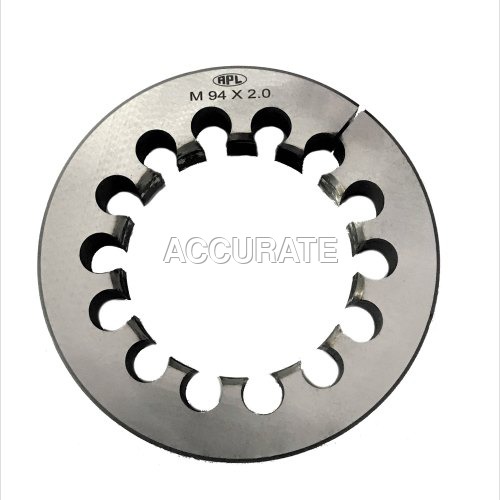
Split dies are adjustable for precision threading of bolts, studs, rods and other pieces that require external threading by hand. Also ideal for cleaning/repairing external threads.
Split Dies that brought to clients by us are utilized to cut new threads in bar. The split is to allow a screw, which is placed in the die stock, to narrow or widen the split and adjust the die so as to cater for variations in diameter. These are well designed and cast by experts using modern tools, and graded metal plate in size of M94x2.0 in accordance with industry standards. Rust proof, ideal diameter, superior finish, and durable, Split Dies can be purchased easily in various sizes, grades and finishes at moderate prices.
Specification
|
Brand
|
APL
|
|
Material
|
HSS (M2)
|
|
Pattern Type
|
Round
|
|
Specialty
|
Special Sizes Available on order
|
|
Outer Diameter
|
Standard and as per order
|
|
Pitch
|
Standard and special pitches available on order
|
|
Country of Origin
|
Made in India
|
Precision Thread Cutting for Diverse ApplicationsSplit Dies are ideal for external thread cutting on various rods, bolts, and pipes. Their robust design ensures precision across a range of thread sizes, making them suitable for industries requiring highly accurate and repeatable results. With compatibility for multiple materials and both manual or machine use, these dies are essential in manufacturing, maintenance, and repair settings.
Adjustable Fit and High DurabilityA screw adjustment slot enables users to fine-tune the die fit, catering to specific tolerances and thread fits. Built from hardened high-speed steel (HRC 60-65), these dies resist wear and support multiple uses. The replaceable and open split design further enhances service life, ensuring reliable performance across diverse threading tasks.
Versatility in Threading OperationsSupporting various thread pitches and capacity sizes from M4 to M24, Split Dies accommodate standard and fine threading needs. Supplied in secure packaging, they are suitable for manual die stocks or lathes, offering users flexibility in operational methods. Optional TiN coating upgrades are available for enhanced performance on tough materials.
FAQ's of Split Dies:
Q: How are Split Dies used for thread cutting?
A: Split Dies are placed in a die stock or lathe, then manually or mechanically rotated over the rod, bolt, or pipe to cut precise external threads. The screw adjustment slot allows for fit tuning before beginning the threading operation.
Q: What materials can I cut threads on using these split dies?
A: These split dies are engineered for use with steel, stainless steel, brass, copper, and aluminum, offering high wear resistance and optimal performance across these metals.
Q: When should I select standard versus fine thread pitch?
A: Choose standard thread pitch for general fastening applications and fine thread pitch when higher vibration resistance or finer adjustment is needed. The available pitches, such as 1.0 mm, 1.25 mm, 1.5 mm, and 2.0 mm, allow you to match application requirements.
Q: Where do these split dies find their primary application?
A: Split Dies are primarily used in the metalworking, manufacturing, automotive, and repair industries for producing or repairing external threads on rods, bolts, and pipes of various materials and sizes.
Q: What is the process for adjusting the fit of a split die?
A: The split die includes a screw adjustment slot. Before threading, you can tighten or loosen the slot to slightly expand or contract the die, fine-tuning the thread fit according to your tolerance needs.
Q: What are the benefits of choosing high-speed steel split dies?
A: High-speed steel provides superior hardness (HRC 60-65), high cutting accuracy, and long service life. These properties make the dies suitable for repeated use, even on tough materials, and ensure reliable, high-precision threading results.
Q: Can these split dies be used with both manual and machine operations?
A: Yes, these dies are designed for compatibility with both hand-operated die stocks and machine operations such as lathes, accommodating a wide range of workshop and industrial threading requirements.

 Send Inquiry



 Send Inquiry


 Send Inquiry

