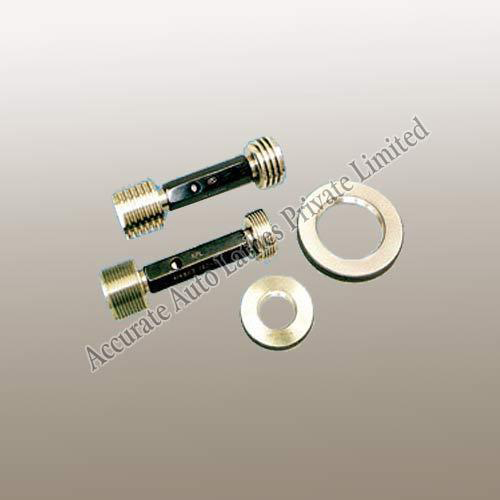
About Buttress Thread Gauges
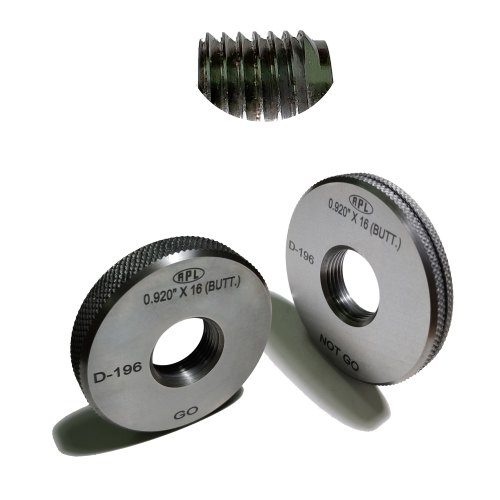
Being a quality-driven entity in this sector, we are deeply immersed in manufacturing the best quality Buttress Thread Gauges at our well-facilitated manufacturing unit with the help of well-experienced workforce. Such gauges are utilized to inspecting thread pitch diameters as well as top diameter sizes. Corrosion resistance, dimensionally accurate, durable and fine finish, these can easily to used due to their precise spiral threads and ideal diameter and size of 0.920"x16. Furthermore, clients can buy Buttress Thread Gauges in desired amounts at nominal prices.
Specification
| Type Of Gauge | Ring Gauge |
| Material | OHNS |
| Brand | APL |
Exceptional Precision and ConsistencyButtress Thread Gauges undergo precision grinding and lapping to achieve a superior surface finish and accurate fit. This process ensures the gauges meet stringent tolerance standards, guaranteed by 5862 HRC hardness and precision-ground construction. Each gauge offers consistent performance for repeated inspection tasks.
Versatile Measurement and CustomizationThese thread gauges are suitable for a broad array of buttress thread sizes, with standard ranges typically between 1" and 8" or as specified by the customer. Customization options allow clients to specify thread dimensions, pitch, and marking requirements, making the gauges adaptable for diverse application needs in manufacturing and inspection.
Protection and DurabilityEach gauge is treated with an anti-corrosive coating and supplied in a dedicated protective box. The robust tool steel construction and anti-rust finish ensure durability, maintaining gauge integrity and measurement accuracy even in demanding workshop and field environments.
FAQs of Buttress Thread Gauges:
Q: How are Buttress Thread Gauges used in inspection and calibration processes?
A: Buttress Thread Gauges are employed by inserting the Go or No-Go Plug & Ring into the buttress-threaded component. The process determines whether thread dimensions adhere to specified standards, facilitating precise calibration during both manufacturing and maintenance.
Q: What standards do these gauges follow, and can they be manufactured to custom specifications?
A: These gauges conform to DIN 513, ISO 2901/2904 standards, and can alternatively be tailored to meet specific customer requirements for thread size, pitch, and marking, ensuring compatibility with unique application needs.
Q: When should Go and No-Go type plug and ring gauges be used?
A: Go gauges are used to verify the minimum material condition, indicating acceptable threads. No-Go gauges confirm that components havent exceeded the maximum material condition, highlighting non-conforming threads. Both are essential for routine quality control and inspection protocols.
Q: Where are these thread gauges commonly applied?
A: They are predominantly used in manufacturing plants, quality assurance labs, and field service operations where buttress-threaded components require precise inspection or calibration to ensure conformity and optimal function.
Q: What benefit does the lapped surface finish and anti-corrosive packaging provide?
A: The lapped surface finish enhances measurement accuracy and fit, while the anti-corrosive coating and protective packaging safeguard the gauges from rust and physical damage, extending their lifespan and maintaining measurement reliability.
Q: How does the marking on each gauge aid usage and traceability?
A: Each gauge is marked with size, pitch, gauge type, serial number, and thread size, making identification straightforward and ensuring traceability for quality management and maintenance records.

 Send Inquiry



 Send Inquiry

 Send Inquiry
